Showing posts with label wooden architecture. Show all posts

Sunday, October 18, 2015

Wooden Churches # 25 - Hrabová Roztoka, Slovakia


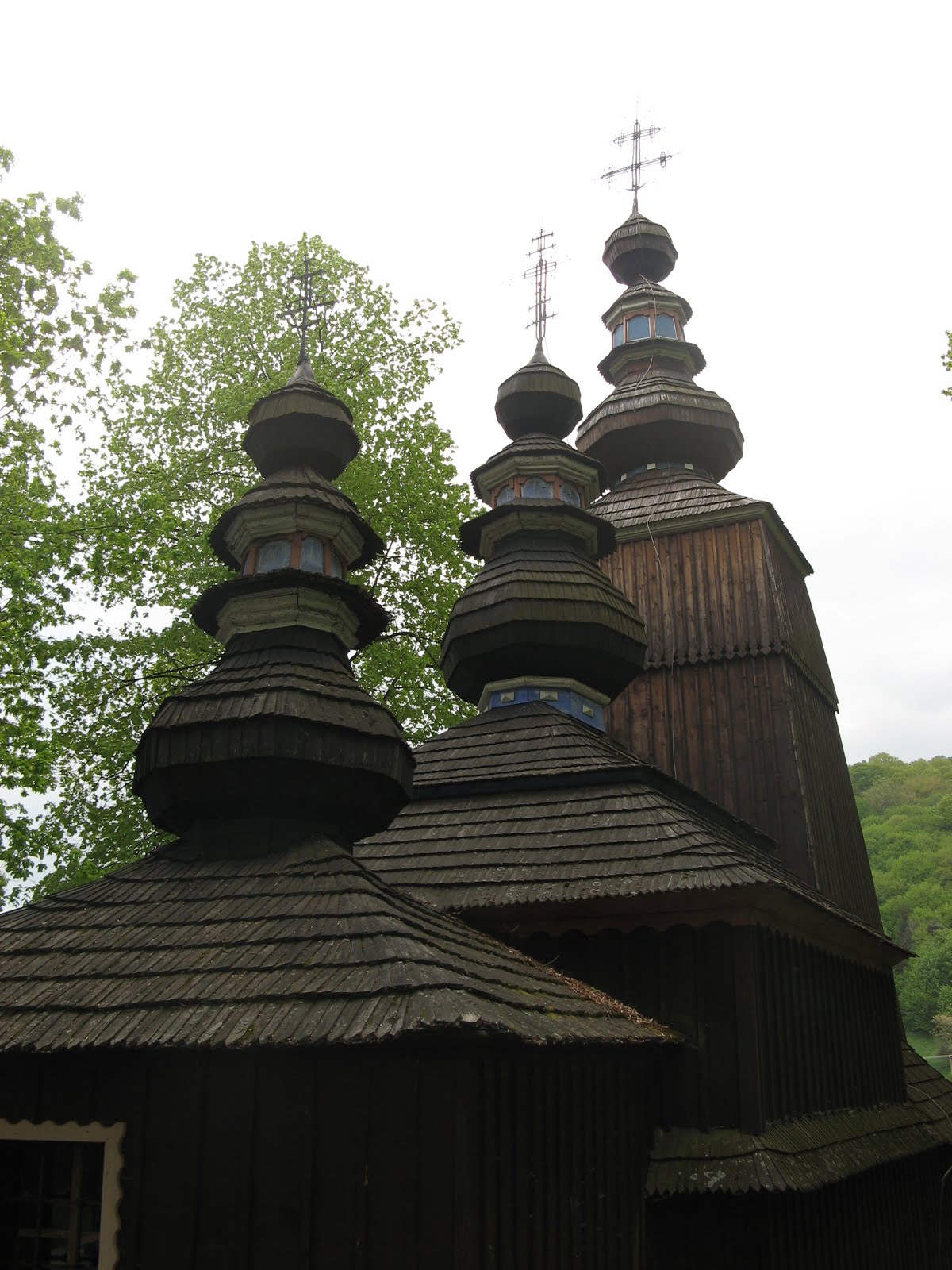
This small Greek Catholic church lies on a hill above the village of Hrabová Roztoka in eastern Slovakia, just a few kilometres from the border with Ukraine. The church was built in the middle of the 18th century and dedicated to Saint Basil the Great. A sign on the rear wall of the church declares it to be a 'national cultural monument' of Slovakia (this type of metal sign is affixed to most of Slovakia's wooden churches), but interestingly a second sign declares it to be 'Ukrainian national architecture' written in the Ukrainian Cyrillic alphabet.


The church has a simple, rustic design which is similar to the nearby church in the village of Ruská Bystrá. It follows a three-room plan with a nave, sanctuary and 'babinec' or entrance room, while above there are two towers with onion domes topped by three-barred iron crosses. In the front tower there are three bells which date from 1796. The roof and exterior walls underwent repairs and replacement of wooden tiles in the year 2000.


The impressive iconostasis in the interior dates from 1794 and is almost as old as the church itself. A rare feature of this church among those in Slovakia is the Czar door, in place of the usual 'Tree of Jesse' doors. In the second row of the iconostasis the image of the Last Supper is in the central position, instead of the more common image of Christ. Five icons were stolen from the church in 2003; they were later recovered, but were damaged and required restoration.


Kalná Roztoka can be reached by infrequent buses from the towns of Snina and Stakčín to the north, while the neighbouring village of Ruská Bystrá has bus services connecting it to the town of Sobrance to the south. Therefore it is possible to see both Ruská Bystrá and Kalná Roztoka in a day by walking along the forest trail between them and arriving and departing from each by bus. The church key keeper lives down the hill in the centre of the village, but they weren't at home when I visited.

Tuesday, October 13, 2015

Wooden Churches # 24 - Slavoňov, Czech Republic


This Roman Catholic wooden church sits on a small hill at the edge of the village of Slavoňov in the East Bohemia region of the Czech Republic. The church was built in 1553 on the site of a much older structure. It was originally founded by Utraquists (a moderate branch of the Hussite movement) and dedicated to Saint Martin, but the church became Roman Catholic in 1683.


The large bell tower within the church yard dates from the same era as the church, probably built in 1555. The lower half of the tower is made of brick and its height suggests it was also intended to have a defensive military function in the event of the village coming under attack. Three bells cast in the seventeenth and eighteenth centuries hang in the tower.


The beams of the church are made of oak, spruce and fir logs. The joints between the logs were filled in with mortar and then the exterior of the building was covered in whitewash. The interior walls and ceiling are painted with murals of plants and flowers which date from the sixteenth to eighteenth centuries. The murals were restored twice in the twentieth century.


Getting to Slavoňov is possible by public transport since there are several buses daily from the nearby town of Nové Město nad Metují which has train and bus links to most major cities across the country. The village is just 4 kilometres east of Nové Město nad Metují so it is also possible to walk there along a forest trail. The church is open for religious services four times per week, and at other times the door into the front entrance room is left open where it is possible to get an obstructed view of the church interior.

Sunday, June 8, 2014

Wooden Churches # 23 - Bodružal, Slovakia


This Greek Catholic church is found on a small hill above the village of Bodružal among the forest covered mountains in the north-eastern corner of Slovakia. The church is dedicated to Saint Nicholas and was built in 1658, making it one of the oldest churches with a Lemko design in the Carpathian region. It was designated as a UNESCO World Heritage site in 2008 together with seven other wooden churches in present-day Slovakia.


The three-part Lemko design (narthex, nave and sanctuary) are intended to represent the holy trinity. An onion dome projects above each of the three room sections with the highest dome placed above the narthex (entrance room) which is a typical feature of the Lemko style. The tower above the entrance contains three bells, the oldest of which was cast in 1759. The iconostasis wall in the interior is entirely original, dating from the 17th century, and is one of the finest examples of icon painting in this region of the Carpathians. The church grounds are surrounded by a low wooden fence with a main wooden entrance gate with a small shingled roof.


The church is in use at least weekly with regular services held on Sunday morning. The key keeper lives 50 metres down the road from the church and since this is a popular church with tourist visitors it's usually not a problem to find someone willing to come and open the door. They will expect an entrance fee of about two Euros per person to be paid, and donations can be left in front of the icons.


There is no direct transportation to Bodružal, but it is an easy 15 minute walk from the village of Krajná Poľana which is on the main road between Svidník and the Polish border and there are frequent buses throughout the day from Svidník. A walking trail through the forests connects four villages with wooden churches (Bodružal, Príkra, Miroľa and Krajné Čierno) which makes a perfect day hike to experience both the villages and the surrounding countryside.

Wednesday, January 29, 2014

Wooden Churches # 22 - Ruský Potok, Slovakia

This small Orthodox church stands on a raised patch of ground in the centre of the village of Ruský Potok in the far northeast corner of Slovakia. The forested hills of the Poloniny National Park surround the village on three sides, and sections of the UNESCO-listed Beech Forests of the Carpathians site are also nearby.
The church was built in 1740 and dedicated to Michael the Archangel as a Greek Catholic church. Since the year 2000 it has been used by the local Orthodox church community, though services are only held on religious holidays and special occasions.
The church contains a three-section floor plan (narthex, nave and sanctuary) on an east-west axis which is typical of Greek Catholic churches found in this region. The church was built on a low stone foundation to enhance its durability.
Next to the church is a small bell tower which contains three bells. The bell tower is not part of the original church plan and was built only in 1956. The three bells it contains were originally housed in the belfry in the tower above the narthex of the church. The tower features a series of small windows, which is a unique feature among the churches found in this region.
The iconostasis in the church likely dates from the eighteenth century. Due to the narrow space available in the small nave, the icons on the far left and right are placed on the side walls at a ninety degree angle to the rest of the iconostasis. This is another very unusual feature which does not appear in any of the other churches in this region.
The church was originally surrounded by a stone wall with two entrance gates, though at present there is a wooden fence with one entrance gate leading down towards the village square. A modern church has been built within the same grounds as the original wooden church.
Ruský Potok is very difficult to reach by public transport, since no buses run to the village and just a few buses per day pass along the Snina - Ulič road four kilometres to the south. The road into the village from the Snina - Ulič main road is paved and fine for access by car or bicycle. There is a blue-marked hiking trail over the hills connecting the villages of Topoľa, Ruský Potok and Uličské Krivé, and since all three villages contain wooden churches this route makes a nice one day trek.

Wednesday, November 21, 2012

Wooden Churches # 21 - Hunkovce, Slovakia

This photogenic Greek-Catholic church stands on a small hill next to the road in the village of Hunkovce in north-east Slovakia. There are Rusyn wooden churches in nearly every village between the town of Svidník and the Polish border, but Hunkovce's church is the only one which can be easily seen from the main road while driving past. The church was built at the very end of the 18th century, probably in 1799, and was dedicated to the Dormition of the Virgin Mary.
The church has a perfect Lemko design plan, with the tallest of three towers above the narthex (entrance area), the middle one above the nave and the lowest above the sanctuary. Each of the towers features intricately detailed onion domes with large ornamented metal crosses in Baroque style placed above. The wooden structure of the building sits on a low stone foundation layer to protect it from water seepage from the ground.
There is a small Greek-Catholic cemetery on the hill surrounding the church, with several cast-iron cross markers that date from the late 19th and early 20th centuries. The small shingle-roofed entrance gate beside the road is all that remains of the traditional wooden fence which once surrounded both the church and cemetery.
The village of Hunkovce saw heavy fighting in the battle for the nearby Dukla Pass in 1944; most of the houses in the settlement were destroyed, and the church suffered extensive damage to the roof and walls. It was later repaired and named a National Heritage Landmark building in 1968. At the southern end of the village there is a large World War Two German military cemetery with the graves of more than 2000 German soldiers who fought in the battle.
In 2010 the exterior of the church was fully reconstructed with new wooden siding and roof shingles (these photos were taken a few months before the restoration). The church is empty and has no interior fittings because the iconostasis and icons were removed and placed in museums in Bardejov and Svidník. No religious services are held here, since there is a modern Greek-Catholic church across the road which serves this purpose for the local villagers. If you'd still like to see the inside of the wooden church, try to find the local priest who is often in the modern church across the road.
Hunkovce is one of the easiest churches to visit in Svidník region because it is directly on the main road to the Polish border and many buses travel along this route daily. The bus from Svidník takes about 20 minutes to reach the village, and it is another 25 minutes from there to the border. After crossing the border on foot, Polish buses run from the border to the towns of Dukla and Krosno. Svidník isn't very aesthetically pleasing, but it is the most convenient place to use as a base when visiting the wooden churches in this region, and the town also has a superb outdoor folk museum and the Ukrainian-Rusyn Cultural Museum.

Monday, November 19, 2012

Wooden Churches # 20 - Tročany, Slovakia

This newly restored church stands in the centre of the small village of Tročany, located south of Bardejov in eastern Slovakia. Research conducted during the past few years has confirmed that the church is much older than had been previously thought; samples taken from its wooden beams were tested and the date of its construction was found to be the end of the 15th century or the first years of the 16th century. This puts it into the same age bracket as the Roman Catholic church in Hervartov, previously believed to be the oldest surviving wooden church in Slovakia. It is among the oldest Greek-Catholic wooden churches in the entire Carpathian mountain region.
Dedicated to Luke the Holy Apostle and Evangelist, the church has a standard Greek-Catholic floor plan with a sanctuary, nave and narthex (entrance area). Above the entrance porch there is a bell tower topped with a very unusually shaped cap which looks like a candle extinguisher. A similarly shaped cap sits above the central nave, while the sanctuary has no cap or steeple attached. The bell tower contains two bells which are still in regular use during religious services. At the top of the cap of the bell tower is a simple double-barred cross, while the cap above the nave has a more decorative single-barred cross.
The interior contains a restored iconostasis from the 17th century, though it is missing some of its original features. Instead of the typical Last Supper scene placed above the middle Czar door there is the Mandilion, a picture of the face of Christ on a cloth without a crown of thorns. In the sanctuary the altar is decorated with an 18th century icon depicting the Descent from the Cross, while the preparatory table in the corner has an icon of Saint Michael the Archangel. There are small windows on the right-hand side of both the nave and the sanctuary which allow some natural light to enter.
Today the church is used by both Greek Catholics and Roman Catholics, so the interior contains some modern Roman Catholic fittings which thankfully do not detract from the beauty of the older Greek Catholic artifacts. The church has undergone several renovations throughout its history, with major work carried out in 1897, 1933 and 1968. In 2010 and 2011 the church was completely restored both inside and out with funding provided by the European Regional Development Fund as part of a cross-border project to promote economic growth and cooperation between south-eastern Poland and north-eastern Slovakia.
The key for the church is kept by a family which lives at the opposite end of the village; if you are standing at the church go left along the road, pass the turning point for the road out to the main highway, continue up the slight incline of the hill and the house is on the right, the second house past the village office. You need to open their front gate and walk up and knock on the door on the right side of the house. The family are used to opening the church every day for visitors and are very friendly (they even speak a word or two of English) and they have pamphlets and books for sale about the Greek-Catholic churches in the region.
Tročany is not serviced by regular bus transport, but it is a two kilometre walk from the village out to the main road running between Bardejov and Prešov, and there is a bus stop at the turnoff to the village where buses pass by every hour or two. Prešov is a major transport hub with train and bus connections throughout the country, while Bardejov is the best place to base yourself for a tour of the wooden churches found in its vicinity.

Friday, November 16, 2012

Wooden Churches # 18 - Maršíkov, Czech Republic

This large timber church stands in the small village of Maršíkov in the Jeseníky region of North Moravia in the Czech Republic. It was built in 1609 using wooden beams taken from an older wooden church which had been dismantled in the nearby town of Velké Losiny. The wooden church in the village of Žárová, a few kilometres north of Velké Losiny, was constructed in 1610 with wood taken from the same dismantled church.
The church in Maršíkov was originally Lutheran, and was dedicated to the Archangel Michael. It is considered to be one of the finest examples of late-period Renaissance folk architecture in the Czech Republic. Up until the early 1900's a low stone wall surrounded the church and the village cemetery which was located directly behind it. The cemetery was moved to a location on higher ground further away from the road.
The interior contains unique Rococo-style decorations from the late 18th century. The main altar includes a painting of the Archangel Michael, while the side altars depict the Virgin Mary and Saint John of Nepomuk. The walls of the nave are covered with timber boards with overlapping joints and are painted in dark red and grey. In the choir above the entrance area there is an organ from the 18th century.
The wooden steeple at the centre of the roof line is topped with a large onion dome which is grander in scale than those usually seen on the 17th and 18th century wooden churches found in this region. The dovetail joint interlocking system used to connect the ends of the wooden beams is typical for wooden churches in Silesia and northern parts of Moravia and East Bohemia.
The key for the church is kept by the family which lives in the house directly in front of the church entrance. They are used to opening it a few times per week for Czech and German bus tour groups, but they may be a little hesitant to do so for individual tourists who come unannounced, especially if they are busy with other activities. Offering them a donation for the church (50 to 100 crowns) might provide the right encouragement.
The village of Maršíkov isn't serviced by buses very frequently, but it is an easy two-kilometre walk from the town of Velké Losiny, which has frequent train and bus connections with Šumperk and Zábřeh, both of which have regular connections with Olomouc, Prague and other parts of the country. There are several restaurants and accommodation options available in Velké Losiny because tourists come to visit the spa, chateau and hand-made paper museum in the town and use it as a base for hiking in the Jeseníky mountains.

Saturday, November 3, 2012

Wooden Churches # 17 - Nová Polianka, Slovakia (now in Svidník Outdoor Museum)

On a hill above the town of Svidník in north-eastern Slovakia lies the Ukrainian and Rusyn Village Museum, a collection of farm buildings, windmills and other historical wooden structures gathered from the surrounding region. The highlight of the museum is the Greek-Catholic wooden church originally from the small village of Nová Polianka, a few kilometres south of Svidník.
The church was built in Nová Polianka by local craftsmen around 1766 (some sources suggest as early as 1763) and was dedicated to Saint Paraskeva. During World War II the church and the village were badly damaged, and a newer brick church built in the 1930's became the main place of worship for the villagers.
The wooden church continued to be used for services until 1960, but in 1961 its condition had deteriorated enough that it was torn down. In the 1980's plans were made to found the Ukrainian and Rusyn Village Museum in Svidník, and it was decided that the church from Nová Polianka should be fully reconstructed for the museum based on the original architectural plans.
Eighteenth-century icons and interior fittings were collected from several different Greek-Catholic churches in the region and used to decorate the interior of the rebuilt structure. The church was opened as a part of the Village Museum in 1986, and since 1993 occasional Greek-Catholic masses and other religious services have been held there.
Built from pine wood, the church has a three-section floor plan in the typical Lemko style, with three accompanying steeples and beautifully decorative wrought-iron crosses above. The steeples and crosses are arranged in height with the highest above the entrance room, the middle one above the nave, and the lowest one above the sanctuary.
The wooden walls of the interior of the original church in Nová Polianka were covered in paintings of scenes from the Bible, but these were not recreated for the church in the museum. The iconostasis dates from the early 18th century and came from a church in a nearby village. There is a royal door at the centre of the iconostasis but the deacon doors for the two side entrances into the sanctuary are missing.
Standing next to the church is a wooden bell tower with a pyramidal shingled roof and an onion-shaped steeple topped with a cross. Two bells have been installed in the tower and are rung on special occasions. surrounding the church and bell tower is a low wooden fence with a shingled top in the Rusyn style which is typical of this region of the Carpathians.
The Village Museum in Svidník is open daily except Mondays from the beginning of May until the end of October. A Rusyn-Ukrainian folk festival is held in the village museum every year in June, attracting thousands of visitors to the event. Svidník is not connected to the railway network, so the most convenient way to get there by public transport is by bus from Prešov, Košice or Bardejov. Regular buses also run north from Svidník to the border with Poland at the Dukla Pass, where it is possible to catch a bus on the Polish side to the town of Krosno.