A travel guide to all aspects of Slovakia and the Czech Republic, focusing on sights and destinations still considered to be off the main tourist trail in these two superb Slavic nations
Friday, March 30, 2012
Day Trips From Bratislava, Slovakia - The Top 40 Destinations
Bratislava is located near the point where the borders of several different countries meet, which means that it is possible to make day trips not only in Slovakia but also in Austria, Hungary and the Czech Republic. Many of Slovakia's most interesting destinations are in the central and eastern parts of the country and are too far away to reach in a day, but I've included the best places to see in southwestern Slovakia along with a good mix of attractions in each of the three neighbouring countries. Vienna is an obvious day trip in Austria, and Budapest is also reachable in a day from Bratislava but I haven't included it in this list since it doesn't make much sense to travel so far to visit a city with as many attractions as Budapest has just for the day. For the purposes of this list I've included destinations that are reachable within three hours of travel by public transport, and given each place a star rating out of five to give you an idea of how worthwhile it is to make the effort to travel there. Instructions are also included for how to get there by public transport starting from the train and bus stations in Bratislava. I've organised the destinations into three categories, those which are within one hour of travel by public transport, within two hours, and within three hours. For more information about the destinations in Slovakia see this post about the Top 100 Destinations in Slovakia and for those in the Czech Republic see this post about The Czech Republic's Top 100 Destinations. The photos included in this post show, from top to bottom, Mikulov (CZ), Esztergom (HUN), Plavecký Castle (SK), Smolenice Castle (SK), and Kopčany Romanesque Church (SK).
Destinations Less Than One Hour Away From Bratislava:
***** Vienna, Austria - (55 minutes to 1 hour) Train from Bratislava main station or from Bratislava-Petržalka station
*** Devín Castle, Slovakia - (20 minutes to 25 minutes) Take Bratislava city bus #28 or #29 from under Nový Most (New Bridge) to Devín village
** Gyor, Hungary - (1 hour) Take the bus with the company called Student Agency from Bratislava main bus station (daily at 11:15am)
** Trnava, Slovakia - (30 minuntes) Train from Bratislava main station
** Hainburg, Austria - (20 minutes) Take Bratislava city bus #901 from under Nový Most (New Bridge) which goes across the border to Hainburg
** Piešťany, Slovakia - (1 hour) Train from Bratislava main station
** Čunovo Art Gallery, Slovakia - (25 minutes) Bus from Bratislava main bus station to the bus stop 'Čunovo Muzeum'
** Modra, Slovakia - (1 hour) Bus from Bratislava main bus station
* Pottenburg Castle, Austria (15 minutes) Take Bratislava city bus #901 from under Nový Most (New Bridge) to the Austrian border village of Wolfsthal, then hike up the red-marked trail to reach the castle ruin
Destinations Less Than Two Hours Away From Bratislava:
**** Mikulov, Czech Republic - (1 hour 50 minutes) Take a train from Bratislava main station to the Czech border town of Břeclav, then change to another local train to reach Mikulov
**** Esztergom, Hungary - (1 hour 25 minutes) Take a train from Bratislava main station to the Slovak border town of Štúrovo, then walk across the bridge over the Danube river to reach Esztergom. The huge dome of the basilica in Esztergom is visible when you get off the train in Štúrovo, so you can use it as a landmark to follow to reach the bridge over the river
*** Trenčín, Slovakia - (1 hour 25 minutes) Take a train from Bratislava main station
*** Čachtice Castle, Slovakia - (1 hour 25 minutes) Take a train from Bratislava main station to Nové Mesto nad Váhom, then change to a local train to reach the village of Višňové which is directly beneath the castle
*** Brno, Czech Republic - (1 hour 30 minutes) Take a train from Bratislava main station
*** Beckov Castle, Slovakia - (1 hour 40 minutes) Train from Bratislava main station to Nové Mesto nad Váhom, then take a bus from outside the train station to the village of Beckov
*** Lednice, Czech Republic - (1 hour 20 minutes) Take a train from Bratislava main station to the Czech border town of Břeclav, then take a bus from outside the train station to reach Lednice
*** Valtice, Czech Republic - (1 hour 35 minutes) Take a train from Bratislava main station to reach the Czech border town of Břeclav, then change to another local train to reach Valtice
** Červený Kameň Castle, Slovakia - (1 hour 10 minutes to 1 hour 20 minutes) Take a bus from Bratislava main station to the village of Častá, then walk up the hill along the road to reach the castle
** Nitra, Slovakia - (1 hour 15 minutes) Take a bus from Bratislava main bus station
** Plavecký Castle, Slovakia - (1 hour 20 minutes) Take a bus from Bratislava main bus station to the village of Plavecké Podhradie, then hike up the hill to the castle ruins
** Smolenice Castle, Slovakia - (1 hour 15 minutes) Take a bus from Bratislava main bus station
** Skalica, Slovakia - (1 hour 20 minutes to 1 hour 50 minutes) Take a train from Bratislava main station to Kúty, then change to a local train to reach Skalica
** Eisenstadt, Austria - (1 hour 10 minutes) Take a train from Bratislava-Petržalka station to Parndorf, then change to another train to reach Eisenstadt
** Trenčianske Teplice, Slovakia - (1 hour 45 minutes to 2 hours) Take a train from Bratislava main station to Trenčín, then take a bus from outside the train station to reach Trenčianske Teplice
* Štefánik Hilltop Monument in Brezová pod Bradlom, Slovakia - (2 hours) Take a bus from Bratislava main station to reach Brezová pod Bradlom, then hike up the red-marked trail to reach the monument
* Tematín Castle, Slovakia - (2 hours) Take a train from Bratislava main station to Nové Mesto nad Váhom, then take a bus from outside the train station to the village of Lúka and walk up the blue-marked trail to reach the castle ruins
* Kopčany Romanesque Church, Slovakia - (1 hour 10 minutes to 1 hour 40 minutes) Take a train from Bratislava main station to Kúty, then change to a local train to reach Kopčany village. Walk from the village across the fields towards the Morava river to reach the church
* Dražovce Romanesque Church, Slovakia - (1 hour 45 minutes) Take a bus from Bratislava main station to Nitra, then change to another bus to reach Dražovce village. The church is on the hill above the village
Destinations Less Than Three Hours Away From Bratislava:
**** Olomouc, Czech Republic - (2 hours 40 minutes) Take a train from Bratislava main station to Břeclav, then change trains to reach Olomouc
**** Visegrád, Hungary - (2 hours 25 minutes) Take a train from Bratislava main station to Szob in Hungary, then change to a local train to reach Nagymaros-Visegrad station. From there walk down to the Danube river and take the passenger ferry across the river to Visegrád on the opposite bank
*** Kroměříž, Czech Republic - (2 hours 25 minutes) Take a train from Bratislava main station to Břeclav, then change to a second train to Hulín, then change to a third train to reach Kroměříž
*** Moravský Krumlov, Czech Republic - (2 hours 30 minutes) Take a train from Bratislava main station to Brno, then change to a local train to reach Moravský Krumlov
*** Znojmo, Czech Republic - (2 hours 45 minutes to 3 hours) Take a train from Bratislava main station to Břeclav, then change to a local train to reach Znojmo
*** Carnuntum Roman Archaeological Site, Austria - (2 hours 15 minutes) Take Bratislava city bus #901 from under Nový Most to Hainburg, then walk southwest along the red-marked trail to reach the town of Petronell-Carnuntum where the Roman site is located
** Gýmeš Castle, Slovakia - (2 hours 10 minutes to 2 hours 25 minutes) Take a bus from Bratislava main bus terminal to Nitra, then change to another bus to the village of Kostoľany pod Tribečom. In the village there is a Romanesque church to see, then hike up the yellow and then green-marked trails to reach the castle on the nearby hilltop
** Sopron, Hungary - (2 hours 20 minutes to 2 hours 45 minutes) Take a bus with the company Student Agency from Bratislava main station to Gyor (daily at 11:15am), then take a train from there to Sopron
** Rust, Austria - (2 hours to 2 hours 15 minutes) Take a train from Bratislava-Petržalka station to Parndorf, change to a second train to reach Eisenstadt, then take a local bus from there to Rust
** Dobrá Voda Castle, Slovakia - (2 hours to 2 hours 20 minutes) Take a train from Bratislava main station to Trnava, then walk out to the bus station outside the train station and take a bus from there to the village of Dobrá Voda. From there hike up the red-marked trail to reach the castle ruins
** Tata, Hungary - (2 hours to 2 hours 20 minutes) Take a bus with the company Student Agency from Bratislava main station to Gyor (daily at 11:15am), then take a train from Gyor to reach Tata
** Komárno, Slovakia - (2 hours 5 minutes) Take a train from Bratislava main station
Monday, March 19, 2012
Top Day Trips from Český Krumlov, Czech Republic
Český Krumlov is an essential stop on anyone's tour of the Czech Republic, and settling in for a few days to fully experience the town's charms and surrounding countryside is highly recommended. There are a number of worthwhile day trips that can be made from Český Krumlov to see more of South Bohemia, such as a hiking trip in the Šumava National Park or a visit to nearby Rožmberk nad Vltavou castle. Here are ten possible destinations that can be reached using public transport, including a star rating out of 5 for each place. All of these options begin from the main train station or bus station in Český Krumlov. For more details on each of these destinations, see the post Top 100 destinations in the Czech Republic. The photos included in this post show, from top to bottom, Tábor, Třeboň and Prachatice.
**** Hluboká nad Vltavou castle - (1hour 15 min to 1 hour 45 min) Bus to České Budějovice, then change to another bus to Hluboká nad Vltavou village
**** Šumava National Park - (1 hour 30 min) For a great one day hike, take the train to Černý Kříž and hike along the yellow-marked trail (five to six hours) past some of the park's finest scenery until finishing at the train depot Ovesná to get the returning train to Český Krumlov
*** Rožmberk nad Vltavou castle - (35 min to 40 min) Bus to Rožmberk nad Vltavou village
*** České Budějovice - (55 min) Take the train for the very scenic journey
*** Jindřichův Hradec - (2 hours to 2 hours 30 min) Bus to České Budějovice, then change to a second bus
*** Tábor - (2 hours 25 min) It's easier to reach as a day trip from Prague, but if you're in Český Krumlov you can get there by train with a change of trains in České Budějovice
** Prachatice - (2 hours to 2 hours 30 min) Bus to České Budějovice, then change to a second bus
** Třeboň - (1 hour 25 min to 2 hours) Bus to České Budějovice, then change to a second bus
** Holašovice folk village - (1 hour 25 min to 1 hour 50 min) Bus to České Budějovice, then change to a second bus
** Kratochvíle chateau - (1 hour 40 min to 2 hours) Bus to České Budějovice, then change to a second bus
Sunday, March 18, 2012
Day Trips from Prague, Czech Republic - The Top 50 Destinations
Prague's central location in the Czech Republic and role as the capital means that all transport connections lead to and from the city, making it possible to reach many destinations around the country as a day trip and even a few across the border in Germany. For the purposes of a day trip I've limited the options to places that can be reached in less than 3 hours of travel by public transport; many travellers prefer short day trips of around one hour of travel and I've included many in that category, but for those who are short on time in the Czech Republic and staying in Prague it can be worth the effort of making longer day trips to see top attractions like Český Krumlov or the Bohemian Switzerland National Park. I've given each destination a star rating out of 5 and grouped them into destinations of one hour of travel or less, two hours or less, and three hours or less. I've included details on how to reach each place using public transport and where the buses/trains depart from in Prague. For more details about things to see in each of these destinations, see the post Top 100 Destinations in the Czech Republic. The photos included in this post show, from top to bottom, Loket, Kolín, Jičín, Jindřichův Hradec and Nelahozeves.
Destinations Within One Hour of Prague:
***** Karlštejn castle - (40 minutes) Train from Prague Hlavní Nádraží station to Karlštejn village
**** Konopiště castle - (45 minutes) Train from Prague Hlavní Nádraží station to Benešov, then walk 1.5 km west through Konopiště park to reach the castle
**** Kutná Hora - (50 min to 1 hour) Train from Prague Hlavní Nádraží station
*** Terezín - (50 min to 1 hour) Bus from outside Prague Holešovice train station
** Mělník - (35 min to 45 min) Bus from outside Prague Holešovice train station
** Nelahozeves - (50 min) Train from Prague Masarykovo nádraží station
** Veltrusy - (35 min) Bus from outside Prague Holešovice train station
** Litoměřice - (1 hour) Bus from outside Prague Holešovice train station
** Pardubice - (1 hour) Train from Prague Hlavní Nádraží station
** Lidice - (20 min) Bus from outside Prague Dejvická metro station
** Lány - (50 min to 1 hour) Bus from outside Prague Hradčanská metro station
* Kolín - (40 min) Train from Prague Hlavní Nádraží station
Destinations Within Two Hours of Prague:
**** Křivoklát Castle - (1 hour 20 min to 2 hours) Train from Prague Hlavní Nádraží station, change to a second train in Beroun
*** Tábor - (1 hour 35 min) Train from Prague Hlavní Nádraží station
*** Plzeň - (1 hour 40 min) Train from Prague Hlavní Nádraží station
*** Hradec Králové - (1 hour 40 min) Train from Prague Hlavní Nádraží station
*** Kokořín Castle - (1 hour 10 min to 1 hour 30 min) Bus from outside Prague Holešovice train station, change to a second bus in Melník
*** Sobotka & Kost Castle - (1 hour 10 min) Bus from outside Prague Černý Most metro station to Sobotka, a hiking trail leads from there through the forest to Kost castle
** Liberec & the Ještěd Tower - (1 hour 15 min) Bus with the company Student Agency which departs from outside Prague Černý Most metro station, take a local tram from outside Liberec train station to reach the Ještěd Tower
** Český Šternberk Castle - (1 hour 45 min to 2 hours) Train from Prague Hlavní Nádraží station, change to a second train in Čerčany
** Jičín - (1 hour 25 min) Bus from outside Prague Černý Most metro station
* Říp Hill - (1 hour 20 min) Train from Prague Masarykovo Nádraží station, change to a second train in Vraňany, then get out in Ctiněves village and walk 1 km along a hiking trail to reach the hill
* Sázava - (1 hour 20 min) Train from Prague Hlavní Nádraží, change to a second train in Čerčany
* Blatná Castle - (1 hour 45 min) Bus from outside Prague Anděl metro station
* Jihlava - (1 hour 45 min) Bus from Prague Florenc bus station
* Žatec - (1 hour 20 min) bus from outside Prague Zličín metro station
Destinations Within Three Hours of Prague:
***** Český Krumlov - (2 hours 55 min) Bus with the company Student Agency which departs outside Prague Anděl metro station. Buy tickets in advance for this bus, especially in summer
**** Karlovy Vary - (2 hours to 2 hours 15 min) Bus from Prague Florenc bus station
**** Dresden (Germany) - (2 hours 15 min) Train from Prague Hlavní Nádraží station
**** Saxon Switzerland National Park & Bastei Bridge (Germany) - (2 hours 20 min to 2 hours 30 min) Train from Prague Hlavní Nádraží station to Bad Schandau, then change to a second train to reach Kurort Rathen. Take the local ferry across the river to beneath the Bastei Bridge, where many hiking trails lead into the park
**** Brno - (2 hours 40 min) Train from Prague Hlavní Nádraží station
**** Olomouc - (2 hours 20 min) Train from Prague Hlavní Nádraží station
**** Telč - (3 hours) Bus from Prague Florenc bus station to Jihlava, change to a second bus to Telč
**** Loket - (3 hours) Bus from Prague Florenc bus station to Karlovy Vary, change to a second bus to Loket
**** Nové Město nad Metují - (2 hours 30 min) Bus from Prague Florenc bus station
**** Litomyšl - (2 hours 20 min) Train from Prague Hlavní Nádraží to Česká Třebová, change to a local bus outside the train station to reach Litomyšl
**** Jindřichův Hradec - (3 hours) Train from Prague Hlavní Nádraží station to Veselí nad Lužnicí, then change to a second train to reach Jindřichův Hradec
**** Bohemian Switzerland National Park - (2 hours 50 min) Train from Prague Hlavní Nádraží station to Děčín, then outside the train station take a local bus to Mezní Louka, where hiking trails begin in the park
**** Czech Paradise National Park - (2 hours 20 min) Train from Prague Hlavní Nádraží station to Turnov, then change to a second train to reach Hrubá Skála, where hiking trails lead into the park
**** Hluboká nad Vltavou Castle - (2 hours 45 min to 3 hours) Bus from outside Prague Anděl metro station to Strakonice or Tábor, then change to a second bus to reach Hluboká nad Vltavou
**** Mariánské Lázně - (3 hours) Train from Prague Hlavní Nádraží station
*** Kuks - (2 hours 25 min) Train from Prague Hlavní Nádraží to Jaroměř, then change to a second train to reach Kuks
*** Třeboň - (2 hours 50 min) Train from Prague Hlavní Nádraží to Veselí nad Lužnicí, then change to a second train to Třeboň
*** Orlík Castle - (2 hours 30 min to 3 hours) Bus from outside Prague Anděl metro station to Písek or Mirovice, then change to a second bus to reach the village of Orlík nad Vltavou where the castle is
*** Zvíkov Castle - (2 hours to 3 hours) Bus from outside Prague Anděl metro station to Písek, then change to a local bus to reach the village of Zvíkovské Podhradí where the castle is
*** Červená Lhota Castle - (2 hours 45 min to 3 hours) Train from Prague Hlavní Nádraží to Soběslav, then outside the station take a local bus to Červená Lhota (this local bus only operates from Monday to Friday, not on Saturday or Sunday)
** Bezděz Castle - (2 hours 50 min to 3 hours) Train from Prague Hlavní Nádraží to Bakov nad Jizerou, then change to a second train to reach Bezděz village
** Prachatice - (2 hours 45 min) Bus from outside Prague Anděl metro station
* Pelhřimov - (2 hours 10 min) Bus from outside Prague Roztyly metro station
* Písek - (2 hours 20 min) Train from Prague Hlavní Nádraží
Friday, February 24, 2012
Wooden Churches # 14 - Hronsek, Slovakia
This beautiful church is located in the village of Hronsek, halfway between the cities of Zvolen and Banská Bystrica in the central region of Slovakia. The most unique feature in the building's design is the clear influence of Scandinavian architectural styles, making it the only church in the country to exhibit such characteristics.
As a protestant church built in the pro-Catholic Austro-Hungarian empire in the early 18th century, it had to be built according to very specific guidelines. In 1681 the Assembly of Sopron had declared that protestant churches had to be constructed according to these strict criteria:
1. The church had to be built in less than one year's time
2. The entire church had to be constructed only of wood, without a single iron nail
3. The church could not have a bell tower (to ensure Catholic churches were more prominent)
4. Entrances to the church could not be made directly from a street
5. The church must be built outside of town and village boundaries.
At this time the Habsburg authorities were doing everything they could to reduce the durability and permanence of Protestant churches, and local officials often tightened the Sopron regulations even further. Hronsek was chosen as the site of a church for the protestant congregations in the northern part of the city of Zvolen and in the surrounding villages. Since just two protestant churches could be built in each region, the churches had to be very large to accommodate many worshippers who would travel long distances to attend services.
Construction of the Hronsek church began in October 1725 on an island in the middle of the river Hron, and the project was completed the following autumn. The architect who created the design is unknown, hence there is much speculation about how the Norwegian and Swedish design elements came to be incorporated into the structure. The connection technique for joining the wooden beams and the arrangement of the interior columns are regarded as examples of this northern style influence.
The church was built to seat 1100 worshippers, both on ground floor pews and on four upper balconies. The seats are angled so that every person in attendance can see the altar clearly. Five different doors allow the building to be filled and emptied more quickly. The interior contains six altar pieces from 1771 which are changed according to the feasts of the ecclesiastical year. The ornate organ was built in 1764 by a local master tradesman from Banská Bystrica.
A 19th-century wooden chandelier hangs from the ceiling in the centre, and the main altar uses wood to recreate the look of marble stone. The interior is illuminated by 30 blown-glass windows in the shape of hexagons which provide plenty of natural light. The central dome of the ceiling has the appearance of the keel of an old sailing ship. The walls were built of red spruce and oak wood with beeswax coating added for durability, and the same wood has survived without replacement until modern times.
The church is also surrounded by huge Linden trees which were planted at the same as its construction. The separate bell tower which stands in front of the church was also constructed at the same time as the church in 1725-1726. The church was inscribed on UNSESCO's World Heritage List in 2008 along with seven other Slovak wooden churches.
The church is used for occasional services, concerts and weddings, but if you arrive and find that it is locked the key is available from the family who live in the house next door. The village of Hronsek is on the local train line between Zvolen and Banská Bystrica, and is also connected by bus with both cities.
Friday, February 10, 2012
Wooden Churches # 13 - Hradec Králové, Czech Republic
This church is found among the trees in Jirásek park in the centre of the city of Hradec Králové, though it has only been located there for a short part of its eventful history. Originally constructed around 1510 in the small village of Habura in north-eastern Slovakia, the structure was first dedicated to Saint Michael the Archanagel as an Orthodox church. In the year 1740 it was dismantled and moved to the neighbouring village of Malá Poľana where it was rebuilt and dedicated to Saint Nicholas the Miracle-worker.
The village was predominantly Greek-Catholic, and the church served the local parish until the early 20th century. During the First World War the region surrounding Malá Poľana was heavily fought over and the church was severely damaged in the fighting. It was fully reconstructed by 1920, but by 1930 the church had been abandoned and was again in poor condition since it had been replaced by a new church in the village which was built of stone.
In 1934 the villagers were preparing to knock the church down and use its timber for other purposes, but an unexpected offer was made to save the structure. The Czech city of Hradec Králové offered to buy the church for 12000 Czechoslovak crowns, an enormous sum for the villagers at that time. During the summer of 1935 the church was again dismantled and packed onto railway cars for its journey to Hradec Králové. Following reconstruction and extensive renovations in its new location in Jirásek park, the church was inaugurated in the autumn of 1935 as a memorial to Czechoslovak soldiers who had died fighting in World War One. The temple has remained in the park ever since, and today it serves the local Orthodox parish with occasional masses still being held there.
The design of the church is in the typical Greek-Catholic Lemko style, with the tallest of the three onion-dome towers rising above the entrance area. The interior decorations have been carefully preserved, and the original iconostasis can still be seen. The church is also surrounded by a small wooden fence as it was in its former location in Malá Poľana.
Jirásek park is just a few hundred metres from the old town square in Hradec Králové, and the city is well-connected by fast train and bus links to Prague and all other cities of the Czech Republic.
The village was predominantly Greek-Catholic, and the church served the local parish until the early 20th century. During the First World War the region surrounding Malá Poľana was heavily fought over and the church was severely damaged in the fighting. It was fully reconstructed by 1920, but by 1930 the church had been abandoned and was again in poor condition since it had been replaced by a new church in the village which was built of stone.
In 1934 the villagers were preparing to knock the church down and use its timber for other purposes, but an unexpected offer was made to save the structure. The Czech city of Hradec Králové offered to buy the church for 12000 Czechoslovak crowns, an enormous sum for the villagers at that time. During the summer of 1935 the church was again dismantled and packed onto railway cars for its journey to Hradec Králové. Following reconstruction and extensive renovations in its new location in Jirásek park, the church was inaugurated in the autumn of 1935 as a memorial to Czechoslovak soldiers who had died fighting in World War One. The temple has remained in the park ever since, and today it serves the local Orthodox parish with occasional masses still being held there.
The design of the church is in the typical Greek-Catholic Lemko style, with the tallest of the three onion-dome towers rising above the entrance area. The interior decorations have been carefully preserved, and the original iconostasis can still be seen. The church is also surrounded by a small wooden fence as it was in its former location in Malá Poľana.
Jirásek park is just a few hundred metres from the old town square in Hradec Králové, and the city is well-connected by fast train and bus links to Prague and all other cities of the Czech Republic.
Sunday, February 5, 2012
Wooden Churches # 12 - Nižný Komárnik, Slovakia
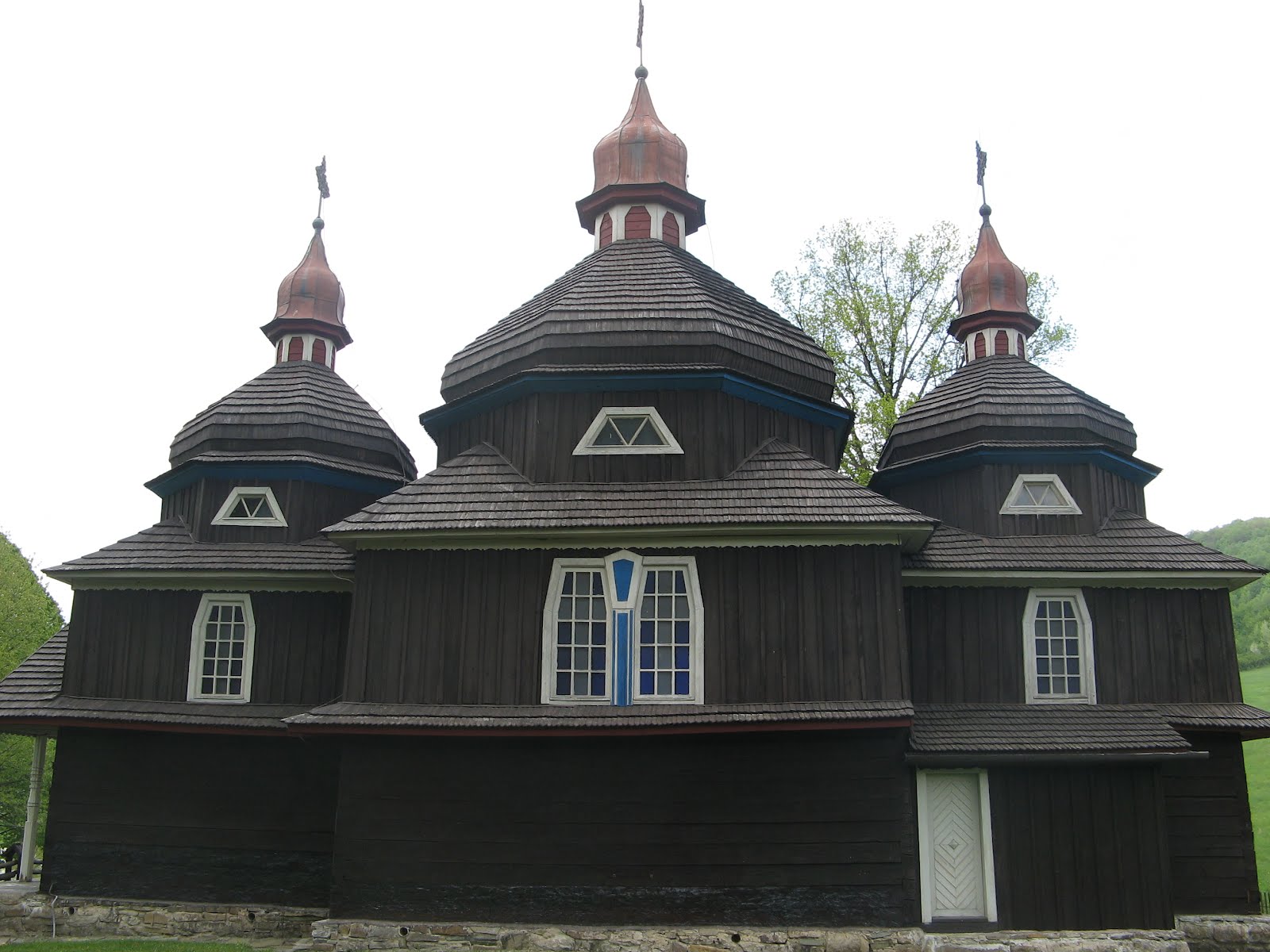
This beautiful church stands at the top of a tall hill overlooking the village of Nižný Komárnik, just a few kilometres from the Polish border in north-east Slovakia. Dedicated to the Protection of the Mother of God, the structure has a unique design among churches in Slovakia, since it is the only one in the country which is of the 'Boyko' style of design, more commonly seen further east in Ukrainian Galicia. The Boyko style typically has three domed towers with the highest tower placed in the centre above the nave, distinguishing it from the 'Lemko' style commonly seen in this region where the highest tower is placed above the entrance area.
Another unique aspect to this church is that its designer is well-known, the Ukrainian architect and explorer Vladimír Sičynský. All other wooden churches in Slovakia were constructed by local builders whose names have been lost to history due to the lack of official records. Sičynský oversaw the construction of the church in 1938, meaning the temple is much younger than most others in the surrounding region. The new church replaced an older baroque wooden church which was pulled down after the modern one was completed.
Another interesting feature of this temple is that it has two entrances, one on the south side leading into the sanctuary and one of the western side. The interior of the church is lit by high windows in both the sanctuary and the nave.
The iconostasis dates from the early 19th century, and it is thought that some of the icons come from the original iconostasis of the first wooden church in the village from the start of the 18th century. The iconostasis has an unusual three-row style since it was not designed for this church and had to be modified by placing the apostles and prophets higher up in the dome. To the north of the church is a large wooden bell tower with a domed roof. The bell tower was partially restored in 2003.
This is one of the most atmospheric churches in the region due to its magnificent hilltop setting above the village. Looking across the valley from the hill you can see a Russian Red Army World War Two aircraft, preserved as a monument to the intense battle for the Dukla pass which took place just north of here. The village is on the main road from Svidník to the Polish border, so buses run to the village quite frequently from Svidník. The key for the church is kept by the family who live in the house directly below the church at the beginning of the path that climbs the hill.
Saturday, November 26, 2011
Wooden Churches # 11 - Broumov, Czech Republic
This church is found at the edge of the town of Broumov in Eastern Bohemia, just a few kilometres from the Polish border. Dedicated to the Virgin Mary, it is the oldest wooden church still standing in the Czech Republic and one of the oldest wooden buildings in Bohemia. The settlement of Broumov was originally founded in 1171 and the first church was constructed on this site a few years later in 1177.
An invasion of the town by Hussite troops in 1421 caused severe damage to the church, and in 1449 it was struck by lightning and burned almost to the ground. The church was completely rebuilt in 1450-1451 in the form that we can see today. A windstorm damaged the tower of the church in 1550, which required extensive repairs. Further alterations to the tower and roof were made in 1811.
The church stands on a stone foundation and follows the plan of an elongated octagon in the Gothic style. Originally there were two entrances, one on the northern side and another on the western side. The roof is dominated by its slender tower which is one of the most striking features of the building's design.
The roofed porch gallery which surrounds the church was originally enclosed with wooden siding, but this was removed in 1779. Wooden planks attached to the walls of the gallery are covered with inscriptions which provide a chronicle of the town's history, recording the years of disasters such as fires, floods, invasions and the plague.
The wooden beams of the ceiling are decorated with stencil decorations of plant and animal themes. These decorations likely date from the time of the reconstruction in 1450, and they have a strong resemblance to those found in wooden churches across the border in Polish Silesia.
The main altar is designed in the rococo style and also features a late-Gothic statue of the Virgin Mary. In 2008 the church was declared a Czech national cultural monument.
The church is open daily for visitors in the summer months, but is kept locked for the rest of the year apart from occasional services and events. Broumov is at the end of a branch railway line with regular local trains running to Starkoč, a station on the main Trutnov - Prague line.
An invasion of the town by Hussite troops in 1421 caused severe damage to the church, and in 1449 it was struck by lightning and burned almost to the ground. The church was completely rebuilt in 1450-1451 in the form that we can see today. A windstorm damaged the tower of the church in 1550, which required extensive repairs. Further alterations to the tower and roof were made in 1811.
The church stands on a stone foundation and follows the plan of an elongated octagon in the Gothic style. Originally there were two entrances, one on the northern side and another on the western side. The roof is dominated by its slender tower which is one of the most striking features of the building's design.
The roofed porch gallery which surrounds the church was originally enclosed with wooden siding, but this was removed in 1779. Wooden planks attached to the walls of the gallery are covered with inscriptions which provide a chronicle of the town's history, recording the years of disasters such as fires, floods, invasions and the plague.
The wooden beams of the ceiling are decorated with stencil decorations of plant and animal themes. These decorations likely date from the time of the reconstruction in 1450, and they have a strong resemblance to those found in wooden churches across the border in Polish Silesia.
The main altar is designed in the rococo style and also features a late-Gothic statue of the Virgin Mary. In 2008 the church was declared a Czech national cultural monument.
The church is open daily for visitors in the summer months, but is kept locked for the rest of the year apart from occasional services and events. Broumov is at the end of a branch railway line with regular local trains running to Starkoč, a station on the main Trutnov - Prague line.
Friday, November 25, 2011
Wooden Churches # 10 - Topoľa, Slovakia
This church is found on a small hill in the village of Topoľa in the north-east corner of Slovakia at the edge of Poloniny National Park. The name of the village means 'Poplar tree' in the Slovak language, and the first record of the settlement dates from 1337. The church is thought to have been built around the year 1700 and is dedicated to the Archangel Michael. The structure has an enormous shingled roof which is disrupted only by a small tower above the entrance topped by a simple pyrimidal steeple.
The eaves are supported by horizontal wooden pillars which support the weight of the oversize roof. The interior of the church contains a well-restored baroque iconostatis from the first half of the 18th century, though not all of its original form has survived. Some of the icons were painted in the 17th century, though the most precious one has been moved to the icon museum in the nearby town of Svidník. The nave has a barrel vault structure and was originally decorated with many icon paintings on canvas.
In the 1960's and 1970's the church underwent renovations which removed the other two towers which originally formed part of the roofline. A small bell tower built in the early 20th century stands in front of the church at the edge of the hill.
Beside the church there is a small cemetery of wooden crosses which act as grave markers for 240 Austro-Hungarian soldiers from the First World War who were killed in action in the region. Regular Greek Catholic services are held in the church for the local congregation; Rusyn identity is strong in the village since it was the birthplace of Alexander Duchnovič, a priest who played a leading role in the 19th-century Rusyn national revival.
Several hiking trails start from Topoľa which continue into Poloniny National Park towards the Polish border, and one trail continues over the hill into the next valley to the west where the village of Ruský Potok contains another Greek Catholic wooden church. A section of forest land near the village is part of the UNESCO heritage listed Primeval Beech Forests of the Carpathians preserve which stretches across the border into Ukraine.
The keys to the church are kept by a couple who live in the house next door to the church on the northern side. They are friendly and helpful and eager to show the church to visitors for a small donation. No buses run directly to the village itself, but several buses per day travel from Snina to Nová Sedlica and stop at the turnoff for the local road to Topoľa two kilometres south of the village.
The eaves are supported by horizontal wooden pillars which support the weight of the oversize roof. The interior of the church contains a well-restored baroque iconostatis from the first half of the 18th century, though not all of its original form has survived. Some of the icons were painted in the 17th century, though the most precious one has been moved to the icon museum in the nearby town of Svidník. The nave has a barrel vault structure and was originally decorated with many icon paintings on canvas.
In the 1960's and 1970's the church underwent renovations which removed the other two towers which originally formed part of the roofline. A small bell tower built in the early 20th century stands in front of the church at the edge of the hill.
Beside the church there is a small cemetery of wooden crosses which act as grave markers for 240 Austro-Hungarian soldiers from the First World War who were killed in action in the region. Regular Greek Catholic services are held in the church for the local congregation; Rusyn identity is strong in the village since it was the birthplace of Alexander Duchnovič, a priest who played a leading role in the 19th-century Rusyn national revival.
Several hiking trails start from Topoľa which continue into Poloniny National Park towards the Polish border, and one trail continues over the hill into the next valley to the west where the village of Ruský Potok contains another Greek Catholic wooden church. A section of forest land near the village is part of the UNESCO heritage listed Primeval Beech Forests of the Carpathians preserve which stretches across the border into Ukraine.
The keys to the church are kept by a couple who live in the house next door to the church on the northern side. They are friendly and helpful and eager to show the church to visitors for a small donation. No buses run directly to the village itself, but several buses per day travel from Snina to Nová Sedlica and stop at the turnoff for the local road to Topoľa two kilometres south of the village.
Wooden Churches # 9 - Lukov-Venécia, Slovakia
This unique church dedicated to Saint Kosmos and Saint Damian stands on the top of a hill at the edge of the village of Lukov-Venécia in north-eastern Slovakia, not far from the city of Bardejov. The village was a regional centre for glass production throughout the centuries, first mentioned in records in 1410. Construction of the church started in 1708 and finished the following year.
The structure features a tall bell tower placed above an entrance area with a porch on the front and sides set on vertical pillars. The tower contains several bells cast between 1755 and 1866. The central tent-roof covers the nave which has an unusually elongated shape for a Greek Catholic church. A large stone foundation allows the structure to sit level on the side of the hill, with enough space below that a cellar is included, making it the only wooden church with a cellar in Slovakia. Most of the interior design is influenced by the baroque style. The iconostasis contains sections painted in different periods, with the upper part dating from 1736 and the lower part from the late 18th century. A number of the icons in the nave are older than this, dating from the 16th and 17th centuries.
The key to the church is kept by the local priest who lives in a house on the opposite side of the village on the road into Lukov. On weekdays a few buses run to the village from the city of Bardejov, but hardly any on Saturdays or Sundays. It is possible to take one of the frequent buses travelling on the main road between Bardejov and Stará Ľubovňa and then get out in the village of Malcov, which is a two-kilometre walk from Lukov-Venécia.
The structure features a tall bell tower placed above an entrance area with a porch on the front and sides set on vertical pillars. The tower contains several bells cast between 1755 and 1866. The central tent-roof covers the nave which has an unusually elongated shape for a Greek Catholic church. A large stone foundation allows the structure to sit level on the side of the hill, with enough space below that a cellar is included, making it the only wooden church with a cellar in Slovakia. Most of the interior design is influenced by the baroque style. The iconostasis contains sections painted in different periods, with the upper part dating from 1736 and the lower part from the late 18th century. A number of the icons in the nave are older than this, dating from the 16th and 17th centuries.
The key to the church is kept by the local priest who lives in a house on the opposite side of the village on the road into Lukov. On weekdays a few buses run to the village from the city of Bardejov, but hardly any on Saturdays or Sundays. It is possible to take one of the frequent buses travelling on the main road between Bardejov and Stará Ľubovňa and then get out in the village of Malcov, which is a two-kilometre walk from Lukov-Venécia.
Thursday, November 24, 2011
Wooden Churches # 8 - Loučná Hora, Czech Republic
This beautiful Roman Catholic church stands in the centre of the tiny village of Loučná Hora in Eastern Bohemia. It is an unusual example of Late Baroque style built of timber, featuring elements more commonly seen only in stone buildings. Its perfectly symmetrical shape also borrows techniques generally used in the design of palaces and castles.
Construction of the present structure started in 1778 and was completed in 1782, though the church stands on the site of an older wooden church which is mentioned in records of the village.
At the time of its construction wood must have been chosen over stone as the building material for economic reasons, since other churches of this style are typically built of stone.
In front of the church stands a separate bell tower which was completely reconstructed in 1942 based on the plans of the original tower. Long ago the grassy area that surrounds the church was the village cemetery, though it has now been moved to an area at the edge of the village. In the church interior the central room serves as the nave, while the eastern end forms the chancel and the western end contains the choir.
The roof is covered with shingles and features mansard-style edging. The church was originally covered in plaster on both the exterior and interior, though this was later removed to reveal the beauty of the wooden beams beneath. The interior of the church is mostly empty nowadays and is used for occasional church services and other village functions.
The village of Loučná Hora is quite easy to reach by train, arriving at the station called Smidary which is less than one kilometre to the south-west. Smidary station is connected by local trains with the town of Chlumec Nad Cidlinou which is on the main rail line between Prague and the city of Hradec Králové.
Construction of the present structure started in 1778 and was completed in 1782, though the church stands on the site of an older wooden church which is mentioned in records of the village.
At the time of its construction wood must have been chosen over stone as the building material for economic reasons, since other churches of this style are typically built of stone.
In front of the church stands a separate bell tower which was completely reconstructed in 1942 based on the plans of the original tower. Long ago the grassy area that surrounds the church was the village cemetery, though it has now been moved to an area at the edge of the village. In the church interior the central room serves as the nave, while the eastern end forms the chancel and the western end contains the choir.
The roof is covered with shingles and features mansard-style edging. The church was originally covered in plaster on both the exterior and interior, though this was later removed to reveal the beauty of the wooden beams beneath. The interior of the church is mostly empty nowadays and is used for occasional church services and other village functions.
The village of Loučná Hora is quite easy to reach by train, arriving at the station called Smidary which is less than one kilometre to the south-west. Smidary station is connected by local trains with the town of Chlumec Nad Cidlinou which is on the main rail line between Prague and the city of Hradec Králové.
Subscribe to:
Posts (Atom)